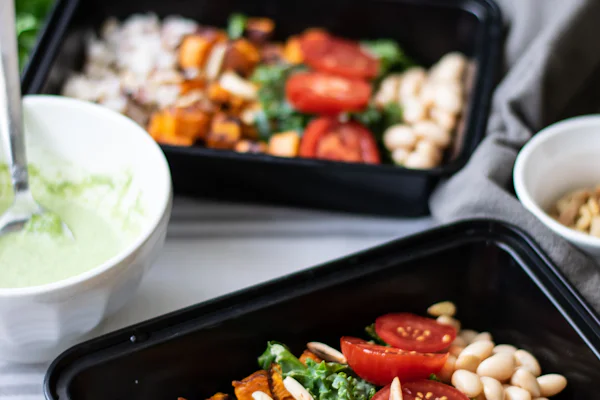
If you want the short version, here it is: most people on a GLP-1 do not need a magic ratio. They need a protein floor, a fat ceiling that matches their stomach, and carb choices that do not crowd out protein. That is the honest answer from the evidence, not the sexy answer from Instagram.
The best proof is the POUNDS LOST trial. Researchers randomized 811 adults to diets ranging from 35% to 65% carbohydrate, 20% to 40% fat, and 15% to 25% protein. After two years, weight loss was similar across the different macro setups. In other words, there was no one winning ratio.
That matters even more on semaglutide and tirzepatide. GLP-1 drugs change appetite and slow gastric emptying, so the question is not just “what ratio burns fat fastest?” It is “what macro setup can I actually tolerate while keeping muscle, energy, and hydration from falling apart?” If you need the broader medication overview first, start with our complete GLP-1 guide. If protecting lean mass is your main concern, pair this with Muscle Loss on GLP-1. If eating enough still feels hard, use this alongside our 7-day high-protein meal plan.
The Only Macro You Should Set First: Protein
When appetite drops, protein is usually the first thing that quietly collapses. Breakfast disappears. Lunch becomes a protein bar if you are lucky. Dinner turns into “I will make it up later,” and later never really happens.
That is a problem because weight loss does not come from fat alone. Some lean mass usually goes with it. During a calorie deficit, the best-supported nutrition move is usually more protein, not less. The PROT-AGE paper recommended at least 1.0 to 1.2 g/kg/day for many older adults, and a later review on muscle health in old age notes that 1.2 to 1.5 g/kg/day may be necessary in older adults dealing with acute or chronic disease rather than relying on the bare RDA floor of 0.8 g/kg/day. Landi et al.
For GLP-1 readers trying to lose weight without giving away more muscle than necessary, a useful working target is:
Protein floor:1.2 g/kg/dayBetter target for active adults or faster weight loss:1.4 to 1.5 g/kg/day
Examples:
150 lb(68 kg): about82 to 109 g/day180 lb(82 kg): about98 to 131 g/day220 lb(100 kg): about120 to 150 g/day
There is no major semaglutide-specific protein trial proving those exact numbers. This is an evidence-based practical range pulled from weight-loss and muscle-preservation research, and that distinction matters. If you have advanced kidney disease or another condition that changes protein needs, your clinician should individualize the target.
Protein Timing Matters More Than Most People Expect
A lot of people look only at the daily total. That misses another problem: distribution. On GLP-1 medications, a giant protein-heavy dinner is often the hardest meal to finish because fullness has been building all day.
That is why spreading protein across meals usually works better than saving it for the evening. In a controlled feeding trial, Mamerow and colleagues found that a more even protein distribution across breakfast, lunch, and dinner increased 24-hour muscle protein synthesis compared with a skewed pattern that loaded most of the protein into dinner. A review focused on older adults also supports practical meal targets in the ballpark of 25 to 35 grams of protein at a time. Landi et al.
Screenshot version:
- breakfast:
25 to 35 g - lunch:
25 to 35 g - dinner:
25 to 40 g - optional snack or shake:
15 to 30 g
If your appetite is tiny, smaller feedings count. Half a sandwich plus Greek yogurt is still better than waiting for a perfect dinner you cannot finish.
Fat: Moderate Wins, Especially if Nausea Is Active
This is where a lot of GLP-1 meal plans get weird. People hear “healthy fats” and start adding nut butter, avocado, olive oil, nuts, and salmon to every meal, then wonder why their stomach feels heavy.
Fat is not bad. But on GLP-1 medication, fat tolerance matters. These drugs slow stomach emptying, and semaglutide has been shown to reduce preference for high-fat foods while lowering energy intake. In real life, greasy or very high-fat meals are one of the most common nausea triggers.
That is why a practical target is usually moderate fat, not ultra-low fat and not keto by default. General adult guidance from the Dietary Reference Intakes places fat in about the 20% to 35% of calories range. Institute of Medicine On GLP-1, it often makes sense to start near the lower or middle part of that range when symptoms are active.
Practical rule:
- rough nausea week: aim closer to
20% to 25% of caloriesfrom fat - stable week with better appetite:
25% to 35%is usually reasonable
Food quality matters too. When you use fat, choose foods that bring something useful with them:
- olive oil
- nuts or nut powder in modest portions
- avocado
- salmon or other fish
- seeds
What usually backfires during dose escalation:
- fried food
- creamy restaurant meals
- very cheesy meals
- giant burgers
- keto-style “fat bombs”
If nausea is the main issue, our best foods to eat on GLP-1 goes deeper on food texture, meal size, and symptom-friendly swaps.
Carbs: Use the Remainder, But Make Them Pull Their Weight
Low-carb content gets clicks, but the actual evidence is less dramatic. Again, the POUNDS LOST trial is useful here: 35% carbohydrate did not clearly beat 65% carbohydrate for long-term weight loss when calories were reduced. So for most GLP-1 readers, the better question is not “how low can I push carbs?” It is “which carbs help me function without crowding out protein?”
The ADA nutrition consensus report makes a similar point in broader metabolic care: there is no single ideal carbohydrate amount for every adult. Quality, food pattern, and individual response matter.
Good GLP-1 carb choices usually do at least one of these:
- add fiber
- are easy to tolerate when appetite is low
- support exercise or energy
- help you hit calories without needing giant portions
Good defaults:
- oats
- fruit
- potatoes
- beans or lentils if tolerated
- Greek yogurt or milk
- rice
- whole-grain toast or wraps
Less helpful as your base carbs:
- juice
- pastries
- candy
- chips that displace protein
- huge refined-carb meals with almost no protein
For fiber, think “build up when tolerated,” not “force 40 grams tomorrow.” A meta-analysis on dietary fiber and constipation found that fiber can increase stool frequency, but if you are in the middle of active nausea, a sudden fiber bomb can feel terrible. On rough weeks, start with softer carbs you can keep down. As symptoms settle, push back toward fruit, oats, legumes, vegetables, and other higher-fiber foods.
The Simple GLP-1 Macro Formula
This is the easiest way to calculate targets without getting trapped in ratio math.
Step 1: Set protein from body weight
Protein grams = body weight in kg x 1.2 to 1.5
Step 2: Set fat from calories and symptom tolerance
Fat grams = daily calories x 0.20 to 0.35 / 9
Use the lower part of the range if nausea or reflux is active. Use the middle or upper part if symptoms are stable and the fats are mostly coming from foods like olive oil, fish, nuts, seeds, and avocado.
Step 3: Let carbs fill the rest
Carb grams = (daily calories - protein calories - fat calories) / 4
Protein calories are protein grams x 4. Fat calories are fat grams x 9.
Personalized Macro Calculator: weight plus activity
If you want a fast starting point instead of doing the math yourself, use the reference table below. It is built for GLP-1 readers who want a practical number quickly, not a perfect sports-dietitian prescription. The protein anchor comes from the same 1.2 to 1.5 g/kg/day range used above, which is consistent with PROT-AGE’s recommendation that older adults generally need at least 1.0 to 1.2 g/kg/day and that higher intakes may be needed in people under more catabolic stress.
[2]
The carb and fat columns are intentionally conservative. They are designed as a cutting-phase starting point for readers whose appetite is lower on treatment, not as a claim that everyone should eat the same ratio. Broader weight-loss evidence shows there is no single winning macro split as long as calories stay controlled. [1]
Personalized macro reference table
Use your current body weight row, then pick the activity column that matches your usual week. Each target is a starting point in grams per day, not a medical prescription.
Sedentary
Protein: 1.2 g/kg
Carbs: 1.5 g/kg
Fat: 0.6 g/kg
Best as a low-appetite baseline when you are mostly walking and doing daily-life activity.
Moderate
Protein: 1.4 g/kg
Carbs: 2.0 g/kg
Fat: 0.7 g/kg
Best for readers doing a few lifting sessions or deliberate cardio sessions each week.
Active
Protein: 1.5 g/kg
Carbs: 2.5 g/kg
Fat: 0.8 g/kg
Best for readers training hard enough that under-fueling shows up in workouts or recovery.
| Body weight | Sedentary | Moderate | Active |
|---|---|---|---|
| 120 lb 54.4 kg | P: 65 g C: 82 g F: 33 g | P: 76 g C: 109 g F: 38 g | P: 82 g C: 136 g F: 44 g |
| 140 lb 63.5 kg | P: 76 g C: 95 g F: 38 g | P: 89 g C: 127 g F: 44 g | P: 95 g C: 159 g F: 51 g |
| 160 lb 72.6 kg | P: 87 g C: 109 g F: 44 g | P: 102 g C: 145 g F: 51 g | P: 109 g C: 181 g F: 58 g |
| 180 lb 81.6 kg | P: 98 g C: 122 g F: 49 g | P: 114 g C: 163 g F: 57 g | P: 122 g C: 204 g F: 65 g |
| 200 lb 90.7 kg | P: 109 g C: 136 g F: 54 g | P: 127 g C: 181 g F: 64 g | P: 136 g C: 227 g F: 73 g |
| 220 lb 99.8 kg | P: 120 g C: 150 g F: 60 g | P: 140 g C: 200 g F: 70 g | P: 150 g C: 249 g F: 80 g |
| 240 lb 108.9 kg | P: 131 g C: 163 g F: 65 g | P: 152 g C: 218 g F: 76 g | P: 163 g C: 272 g F: 87 g |
| 260 lb 117.9 kg | P: 142 g C: 177 g F: 71 g | P: 165 g C: 236 g F: 83 g | P: 177 g C: 295 g F: 94 g |
| 280 lb 127.0 kg | P: 152 g C: 191 g F: 76 g | P: 178 g C: 254 g F: 89 g | P: 191 g C: 318 g F: 102 g |
| 300 lb 136.1 kg | P: 163 g C: 204 g F: 82 g | P: 191 g C: 272 g F: 95 g | P: 204 g C: 340 g F: 109 g |
How to use it:
- Pick the row closest to your current body weight.
- Use
sedentaryif you are mostly walking plus normal daily activity,moderateif you are doing a few structured workouts per week, andactiveif you are training hard enough that low intake shows up in performance or recovery. - If the carb target feels too high for your appetite, lower carbs first before you cut protein.
- If you do long endurance sessions, the
activecolumn may still undershoot your carb needs.
Example at 1,700 calories
For a 180-pound person (82 kg) aiming for about 115 g protein:
- protein:
115 g=460 calories - fat:
55 g=495 calories - carbs:
1,700 - 460 - 495 = 745 calories - carb target:
745 / 4 = about 186 g
That is not “too many carbs” by definition. It is just the math after you set protein and moderate fat. If that carb amount feels too high for your appetite, the fix is usually to raise protein a bit, raise fat a bit if tolerated, or lower total calories only if intake was set unrealistically high in the first place.
Three Macro Setups That Usually Work Better Than Chasing Perfection
1. Low-appetite week
Best for: first month, dose increases, active nausea
- protein first
- moderate-to-lower fat
- easy carbs
Think: Greek yogurt, protein shakes, eggs, rice, potatoes, toast, fruit, soup.
2. Muscle-protection setup
Best for: readers lifting, worried about lean mass, or losing quickly
- protein toward the upper end:
1.4 to 1.5 g/kg - enough carbs to train well
- moderate fat
Think: four protein feedings, planned post-workout meal, fewer empty-calorie snacks. Our muscle-loss guide goes deeper on this.
3. Constipation-prone setup
Best for: appetite is improving but bowel habits are slowing down
- protein stays set
- fats stay moderate
- carbs shift toward higher-fiber choices
Think: oatmeal, kiwi, beans, berries, potatoes, lentils, whole grains, cooked vegetables, plus hydration.
The Honest Bottom Line
Most GLP-1 readers do not need to memorize a macro ratio. They need a system:
- Set protein first.
- Keep fat moderate enough that your stomach can handle it.
- Use carbs strategically instead of fearfully.
That is less exciting than “the perfect Ozempic macro split,” but it is closer to what the evidence supports. If you want the most practical place to start, use 1.2 to 1.5 g/kg for protein, keep fat around the lower-to-middle part of the normal range when symptoms are active, and let carbs fill the rest with foods you actually tolerate.
If eating enough still feels harder than doing the math, that is usually the real bottleneck. Start with our 7-day high-protein meal plan for GLP-1 users and get on the newsletter for more practical meal guides, symptom cheat sheets, and week-by-week GLP-1 nutrition templates.