In the SURMOUNT-1 body-composition substudy, about 25% of the weight lost on tirzepatide came from lean mass. That does not mean GLP-1 drugs are uniquely “eating your muscle.” It does mean the exercise plan matters if you want more of the loss to come from fat. Lean mass means everything in your body that is not fat, including muscle, water, organs, and bone. For most readers, the practical concern is muscle.
The honest version is this: GLP-1 drugs do not create a brand-new muscle-loss problem. Significant weight loss of any kind usually lowers both fat mass and lean mass. What changes on semaglutide or tirzepatide is that appetite can fall fast enough that people under-eat, stop lifting, and lose the training stimulus that normally tells the body to keep muscle.
That is why exercise matters here. For the bigger picture on how these drugs work, start with our GLP-1 basics pillar. If you want the nutrition side too, read Muscle Loss on GLP-1: Protein Strategies to Protect Your Gains and our high-protein GLP-1 meal plan. If low energy is the main barrier, the next read is our GLP-1 fatigue timeline.
The Actual Numbers: Why Training Matters
This is the part most readers want straight. In the SURMOUNT-1 body-composition substudy, adults on tirzepatide lost 21.3% of body weight by week 72. About 75% of that loss came from fat mass and about 25% came from lean mass. That is not a disaster. It is also not nothing.
Semaglutide data point in the same direction. In the SUSTAIN 8 body-composition substudy, adults on semaglutide lost lean mass in absolute kilograms, even while body-fat percentage improved. That pattern is typical in calorie restriction: body composition often gets better overall, but lean tissue still falls unless you actively defend it.
That is the framing to keep in mind. The job of exercise on a GLP-1 is not to stop every gram of lean-mass loss. The job is to shift the ratio so more of the weight loss comes from fat and less comes from lean tissue.
Why Resistance Training Has the Best Return
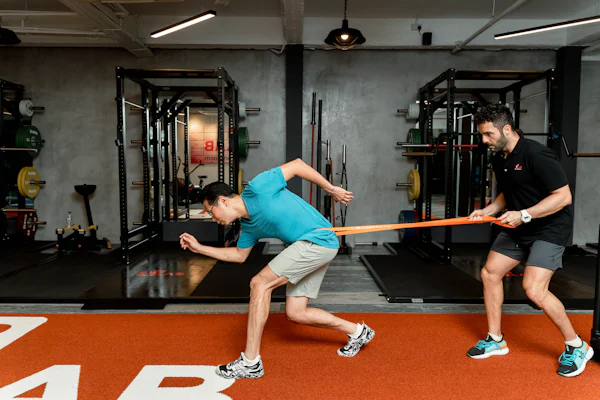
If you only do one kind of exercise on a GLP-1, resistance training is the best pick for muscle retention.
The evidence is not built from one perfect semaglutide lifting trial. It is broader than that. In the Lundgren trial, people who combined exercise with liraglutide had better body-fat outcomes and healthier weight-loss maintenance than medication alone. Liraglutide is not tirzepatide, but it is still a GLP-1 receptor agonist, so the practical lesson transfers well.
Systematic reviews support the same direction. The 2022 Obesity Reviews meta-analysis found that resistance training improved lean mass and body composition in people with overweight or obesity, and that resistance training combined with caloric restriction was especially effective for lowering body fat. The newer 2025 BMJ Open Sport & Exercise Medicine meta-analysis found that adding resistance exercise during dietary weight loss improved strength and reduced the loss of fat-free mass compared with diet-only approaches.
That does not mean cardio is useless. It means cardio and lifting are not interchangeable if your goal is muscle retention.
The Minimum Effective Dose: What Most People Can Actually Sustain
The official baseline for adults is still the Physical Activity Guidelines for Americans: 150 to 300 minutes of moderate aerobic activity each week plus muscle-strengthening work on 2 or more days each week. Those guidelines are for public health, not specifically for GLP-1 users, but they give a practical floor.
For muscle retention during GLP-1 weight loss, the highest-yield starting point is:
2 to 3full-body resistance sessions each week4 to 8hard sets per major muscle group per week- mostly basic movements you can repeat and progress
That weekly volume is an inference from the broader resistance-training literature, not a GLP-1-specific rule. The reason it is a useful inference is simple: it is enough work to matter, but not so much that low appetite and inconsistent energy make the plan collapse.
A lot of readers do worse with a “perfect” five-day split than with two honest full-body sessions they can repeat every week.
Cardio: How Much Is Too Much in a Calorie Deficit?
Most GLP-1 readers are asking the wrong cardio question. They ask, “How much cardio do I need to burn more?” The better question is, “How much cardio can I recover from while I am eating less and still trying to keep my muscle?”
The evidence is mixed on a precise upper limit. There is no clean published threshold where cardio suddenly becomes “too much” for everyone on semaglutide or tirzepatide. That is worth saying plainly.
The evidence shows:
- general health guidelines still start at
150 minutesper week of moderate cardio, not extreme volumes - the 2024 aerobic-exercise meta-analysis found that even modest doses of aerobic exercise were associated with weight and fat-loss benefit in adults with overweight or obesity
- resistance training is the more reliable tool for lean-mass protection during weight loss
So the practical answer is this:
- keep cardio in for heart health, work capacity, and extra energy expenditure
- start with
2 to 4sessions per week, often20 to 40 minutesat an easy to moderate pace - if your legs are always dead, your lifts are getting worse, or you are too wiped out to hit protein targets, the cardio dose is probably too high for your current calorie intake
Walking is usually the easiest default because it adds activity without beating up recovery. Hard intervals can still fit, but they should earn their place rather than being the automatic plan.
Workout Timing Around Injection Day
There is no formal trial-based workout schedule that says you must train on day 4 after the shot or avoid day 1 completely. If someone gives you a rigid rule there, they are making it up.
What we do have are side-effect patterns from prescribing information and patient experience. The Wegovy label and Zepbound label both show the broader GI and fatigue burden that can affect training quality, especially during dose escalation. So the practical rule is to match your harder sessions to your better days.
If your shot pattern looks like this:
- day 1 to 2: lower appetite, more nausea, more fatigue
- day 3 to 5: steadier energy
- day 6 to 7: best training window
Then use that pattern instead of fighting it.
Simple template:
- injection day or next day: walk, mobility, easy bike, or lighter lifting
- middle of the week: your hardest strength session
- late week: second hard session or your longest cardio session
If your symptoms are mild, you may not need any timing adjustments at all.
Exercise-GI Side Effect Correlation Guide
Here is the part most exercise articles skip: different workouts do not irritate the stomach the same way. We do not have a randomized GLP-1 trial comparing HIIT versus yoga for nausea. So the table below is a practical risk map built from three things: official GLP-1 labeling showing nausea, vomiting, dyspepsia, fatigue, and reflux are common and often cluster during dose escalation; reflux studies showing that running and some weight work provoke more reflux than lower-agitation exercise; and exercise-GI reviews showing that harder, more dehydrating sessions raise GI symptom risk. [9] [10] [11] [13] [14]
| Exercise type | Practical GI risk when symptoms are active | Why it tends to feel better or worse | Best use on a rough GLP-1 week |
|---|---|---|---|
HIIT | High | Hard intervals push intensity, heat, and dehydration fast. Exercise-GI reviews consistently tie intense effort and reduced splanchnic blood flow to more nausea and gut symptoms. [13] [14] [15] | Save for your best energy day, and skip it entirely during active vomiting, reflux, or dose-step weeks. |
Running | High | Running causes the most body agitation in the reflux studies, and both classic and modern reflux experiments found more reflux during running than easier modalities. [11] [12] | Best later in the week if your shot reliably hits your stomach for 24 to 72 hours. |
Swimming | Moderate* | Direct GLP-1 swimming data do not exist. In practice it usually lands below running but can still feel rough if reflux is active or you hate horizontal positions after meals. | Use only on lower-symptom days, and keep it easy to moderate if your stomach feels unsettled. |
Weights | Moderate | Resistance work is still the best muscle-retention tool, but heavier bracing and some lifts can aggravate reflux. In the JAMA exercise-reflux study, the weight routine triggered reflux in some participants. [11] | Keep it in, but shorten sessions and avoid grinding sets when nausea or reflux is flaring. |
Walking | Low | Lower-intensity movement usually gives the stomach the least reason to rebel. A small post-meal reflux study found walking reduced postprandial acid exposure. [16] | This is the safest default on injection day, after a dose increase, or on any week your appetite is shaky. |
Yoga | Low to moderate* | Gentle mobility work is usually fine, but deep twists, compression-heavy poses, and long inversions can feel worse if reflux is already active. Abdominal compression is a known reflux trigger. [17] | Use for mobility and recovery, and skip compression-heavy poses on bad reflux days. |
* These ratings are synthesis, not direct head-to-head GLP-1 trial data. They are meant to help you choose the least irritating option on a symptomatic week, not to pretend the evidence is more precise than it is.
The best days to do intense exercise relative to injection day
If your side effects follow a pattern, your training week should follow that pattern too. The label-based part is real: Wegovy and Zepbound both have a high GI side-effect burden, and Zepbound specifically notes that most nausea, vomiting, and diarrhea events happen during dose escalation and decrease over time. [9] [10]
| Timing relative to shot | Best training choice | Why |
|---|---|---|
Injection day | Walking, mobility, easy bike, or complete rest | This is the lowest-margin day if the shot tends to bring early nausea, burping, reflux, or fatigue. |
Day 1 after shot | Light to moderate weights or easy cardio only if symptoms are mild | If you already know day 1 is a bad stomach day, do not force intervals here. |
Days 2 to 3 | First hard strength session or moderate cardio | Many people are settling by this point, especially once they are off the newest dose step. |
Days 4 to 6 | HIIT, long run, or your hardest lifting session | This is often the best window for intense work because hydration, meal intake, and GI tolerance are steadier. |
Dose-escalation week | Drop one intensity level across the whole week | When you are moving up a dose, the smarter play is often to keep the habit but lower the strain. |
The point is not superstition about day 4. The point is load matching. Put your most stomach-sensitive work on the days when your stomach is least likely to fight you.
Practical Tips for Managing Exercise-Induced Nausea on GLP-1
If training is making your stomach worse, the fix is usually boring and mechanical:
- Do not start hard exercise on an almost-empty tank and then wonder why you feel shaky. If you cannot manage a full meal, even a small carb-plus-protein snack can be enough to take the edge off.
- Separate your biggest meal from your hardest workout. Post-meal reflux is easier to trigger, and hard exercise already reduces splanchnic blood flow. [15] [16]
- Downshift before you quit. A
20-minutewalk or a shortened lifting session usually preserves the habit better than forcing a brutal workout and spending the rest of the day nauseated. - Avoid exercises that combine abdominal compression with high effort when reflux is active. Heavy bracing, repeated burpees, and compression-heavy core work are common offenders. [11] [17]
- Treat dehydration as a training problem, not just a comfort problem. The GLP-1 labels both warn that persistent nausea, vomiting, and diarrhea can lead to volume depletion and kidney injury. [9] [10]
- If you are vomiting, unable to keep fluids down, or getting chest-burning reflux after nearly every session, scale back and contact your prescriber rather than trying to out-tough it.
A 3-Day Beginner-Friendly Strength Template
This is not a bodybuilding program. It is a muscle-retention plan for someone losing weight on a GLP-1.
Day 1
- goblet squat or leg press:
3 x 6 to 10 - dumbbell bench press or push-up:
3 x 6 to 10 - seated row or chest-supported row:
3 x 8 to 12 - Romanian deadlift:
2 x 8 to 10 - plank:
2 rounds
Day 2
- split squat or step-up:
3 x 8 to 10each side - overhead press or machine press:
3 x 6 to 10 - lat pulldown:
3 x 8 to 12 - hip hinge variation:
2 x 8 to 10 - farmer carry:
2 rounds
Day 3
- leg press or squat variation:
3 x 8 to 12 - incline dumbbell press:
3 x 8 to 12 - cable row or pulldown:
3 x 8 to 12 - hamstring curl or glute bridge:
2 x 10 to 15 - side plank or dead bug:
2 rounds
Keep 1 to 3 reps in reserve on most sets. That means you stop with a little room left instead of grinding every set to failure. Add weight, reps, or control over time. Progress does not need to be dramatic. It just needs to exist.
The Weekly Plan Most Readers Can Stick To
If you want the screenshot version, use this:
Monday: 30-minute walkTuesday: full-body strengthWednesday: easy cardio or extra walkingThursday: full-body strengthFriday: rest, mobility, or short walkSaturday: optional third strength day or moderate cardioSunday: rest
That is enough for many people. The mistake is assuming you need a punishing plan because the medication is doing some of the appetite work for you. You do not. You need a plan that survives low-appetite weeks and still sends a strong enough signal to keep muscle.
Signs Your Current Plan Is Not Working
The red flags are usually practical, not dramatic:
- your lifts are falling every week
- your recovery is worse than your schedule explains
- you dread training because you are under-fueled
- your protein intake crashes on injection day and never fully recovers
- cardio keeps increasing while lifting quietly disappears
If that is happening, the fix is usually not more effort. It is a better split, less junk volume, or better fueling around the sessions that matter most.
Bottom Line
GLP-1 medications can help you lose a lot of body weight, but they do not remove the basic rules of body composition. If you want to keep more muscle while the scale goes down, resistance training is the highest-return move. Start with two real strength sessions each week, keep cardio at a recoverable dose, and schedule harder sessions on the days your appetite and energy are best.
There is no magic workout on semaglutide or tirzepatide. There is just the boring effective stuff: lift consistently, walk often, eat enough protein, and stop confusing more exercise with better exercise.
If you want more screenshot-friendly GLP-1 guides like this, join the email list for practical explainers on side effects, meal structure, and how to keep your results once the first months are over.